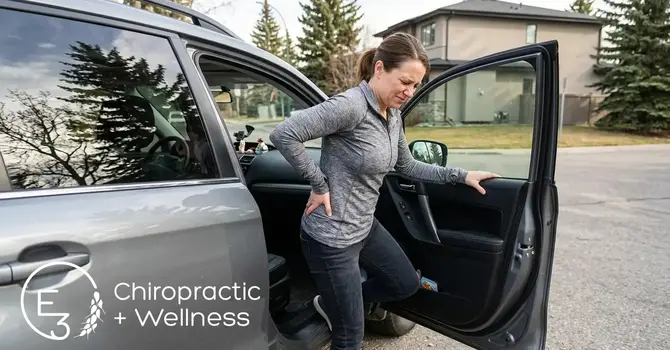
Think about how many times you bend forward in a single day.
You bend down to unload the dishwasher. You reach into the bottom drawer of your fridge. You tie your shoes, pick up a laundry basket, grab your kids' backpack off the entry rug, or pick up a fallen leaf bag in the yard.
For most people, it’s automatic. But if you’re reading this, chances are that simple act of bending forward has started making you hesitate.
Maybe every time you lean forward, you feel a sharp pinch right across your beltline, a deep toothache-like throb in your lower back, or a strange zing traveling down into your hip or leg. You find yourself holding your breath, bracing against the kitchen counter, or using your hands to "walk" yourself back up to a standing position.
If this sounds like your daily reality, don't panic.
Bending over shouldn't feel like playing Russian roulette with your spine. At E3 Chiropractic + Wellness in Saskatoon, back pain triggered by bending or reaching is one of the most common issues we help patients resolve.
Let's break down why leaning forward causes so much trouble, why your back isn't as fragile as it feels, and how learning one simple movement habit can give you your confidence back.
Your Spine vs. Your Hips: The "Shock Absorber" Rule
To understand why bending forward causes pain, we need to look at how your lower body is designed to share workload.
Think of your lower body like a car's suspension system.
Your hips are your heavy-duty shock absorbers. They are wrapped in massive, powerful muscle groups—your glutes and hamstrings—and feature large ball-and-socket joints built to absorb hundreds of pounds of force without flinching.
Your lower spine, on the other hand, is built primarily for stability and protection. It houses your spinal cord and delicate nerve roots.
When you bend down to pick something up, your hips are supposed to do 80% of the work by hinging backward, allowing your upper body to lower while keeping your spine in a strong, neutral position.
But what happens if your hips are stiff from sitting at a desk or driving around Saskatoon all day?
When your hip "shock absorbers" lock up, your lower back is forced to pick up the slack. Instead of hinging at the hips, you round through your lower spine. Doing that once or twice might not hurt, but repeating that rounded-spine movement dozens of times a day places massive pressure on your spinal discs, irritates local nerves, and causes your lower back muscles to seize up in self-defense.
What Is a "Hip Hinge" (And Why Does It Matter?)
If you've ever heard us talk about the hip hinge in our clinic, it simply means moving at your hip joints while keeping your spine relaxed, straight, and supported.
Imagine your body is a pocket knife. When a pocket knife closes, the blade folds cleanly at the hinge joint while the rest of the metal stays straight.
When you perform a proper hip hinge:
-
Your hips slide backward as if you're trying to touch a wall behind you with your tailbone.
-
Your chest gently tilts forward while your spine stays flat.
-
Your glutes and hamstrings stretch and carry the load, keeping all the pressure off your lower back discs and nerves.
When you master this simple movement pattern, lifting a laundry basket, picking up groceries, or working in the garden stops being a threat to your back.
How We Help You Move Pain-Free at E3 Chiropractic + Wellness
If bending over is currently painful, telling you to "just hinge at your hips" isn't always enough—especially if restricted joints or muscle spasms are blocking your hips from moving properly in the first place!
Here is how Dr. Zach, Dr. Layne, and I help you get back to bending and lifting safely:
1. Unlocking Restricted Joints
If your sacroiliac (SI) joints or lumbar spine vertebrae are locked up, your body naturally avoids hinging. Precise chiropractic adjustments restore normal joint motion, taking mechanical stress off inflamed tissues and nerves.
2. Calming Overactive Muscles
When your lower back is in protective spasm mode, we use hands-on care and gentle movement to convince those tight muscles to relax, making room for your glutes to wake up and do their job.
3. Hands-On Coaching
We don't just treat you on the table—we retrain your movement. We coach you through simple, zero-pain drills right in the clinic so you feel 100% confident bending, reaching, and lifting in your everyday life.
Try This Simple Hip Hinge Cue Today
The next time you need to reach down for something on the floor, try this simple visualization to protect your back:
-
Pinch the Orange: Imagine holding an orange between your shoulder blades to keep your chest open.
-
Push the Wall: Stand a few inches in front of a chair or wall. Instead of bending down at your waist, push your hips backward until your tailbone gently taps the wall or chair edge behind you.
-
Squeeze Your Glutes: Soften your knees slightly, keep your feet flat, and squeeze your butt muscles as you stand back up. You should feel the effort in the back of your thighs and glutes—not your lower back!
Reclaim Your Confidence in Movement
You don't have to live in fear of bending over, picking up your kids, or staying active around your house and yard. Your spine is remarkably strong and resilient—it just needs your hips to step up and carry their fair share of the weight.
If you’re tired of feeling a sharp pinch every time you lean forward, or if lower back stiffness is holding you back, our team at E3 Chiropractic + Wellness is ready to help you find long-term answers.
When you’re ready, click HERE to book a discovery call with us today, and start getting some real answers.