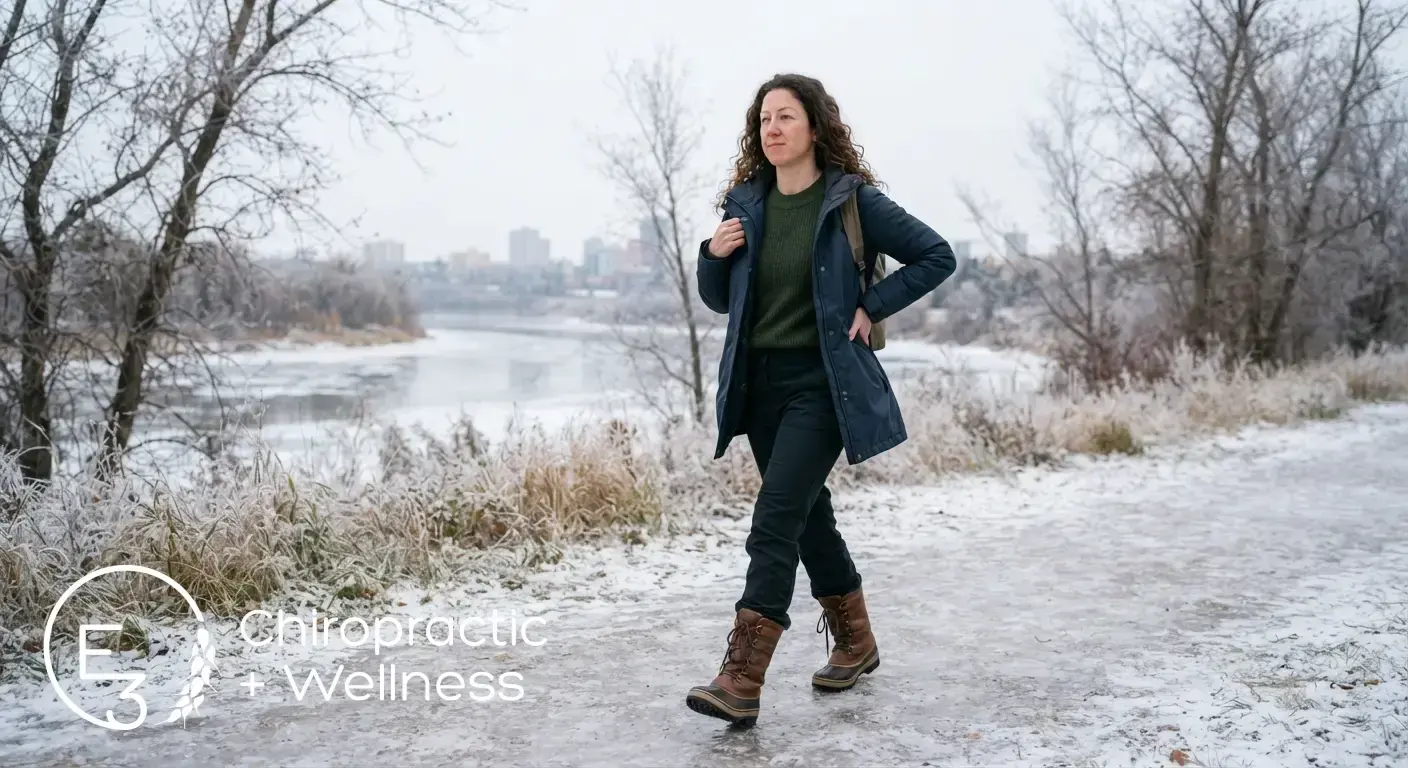
It’s that time of year in Saskatoon when stepping outside means navigating frosted sidewalks, slick patches along the Meewasin trail, and slushy parking lots.
You pull out your winter boots, step onto the pavement, and immediately feel yourself change the way you walk. You take shorter, cautious steps, stiffen your lower body, and brace your core against a potential slip.
But by the time you reach your front door or walk into your office, you notice a familiar, unwelcome sensation: a deep, burning ache in your lower back, or a shooting zing of sciatica pain traveling down into your hip, leg, or foot.
If this happens to you as soon as winter gear comes out, don't panic.
At E3 Chiropractic + Wellness, sciatica and pelvic flare-ups spike every mid-November as icy conditions arrive. Most people think their leg pain is triggered purely by heavy lifting or poor posture, but the way your feet hit the ground in winter footwear plays a massive, overlooked role in keeping your nerve pathways clear.
Let's break down why winter walking triggers sciatica, how your boots affect your spine, and how we can keep you moving safely and pain-free.
The "Tread and Alignment" Analogy
To understand why winter walking aggravates your sciatic nerve, imagine driving a vehicle on winter roads with unaligned tires.
If your vehicle’s alignment is straight, the tires roll smoothly, gripping the road and absorbing bumps evenly. But if one wheel is slightly misaligned, driving over slippery terrain forces the vehicle's suspension system to work twice as hard to keep you moving straight. The tires wear down unevenly, and the frame absorbs all the vibration.
Your legs, pelvis, and feet act as the alignment system for your lower spine.
When you put on heavy winter boots—which are often rigid, flat, or thick-soled—your ankle mobility changes. Add in the subconscious instinct to tense up and shuffle over icy patches, and your hips and pelvis lock up to create stability.
Instead of your ankles and hips smoothly absorbing impact, every step transfers rigid shock directly into your sacroiliac (SI) joints and lower lumbar spine. If a nerve root in your lower back is already sensitive, that repetitive, tense impact compresses the sciatic nerve "hose," sending pain shooting down your leg.
The 3 Winter Sciatica Triggers
Walking in winter conditions introduces a few unique mechanical challenges:
-
The "Icy Shuffle": Shuffling your feet while locking your knees and hips keeps your pelvic muscles in a constant state of high tension, squeezing deep hip muscles like the piriformis directly onto your sciatic nerve.
-
Rigid Winter Boots: Heavy, stiff boots restrict your foot’s natural arch and ankle movement, forcing your lower back to bend more with every stride.
-
The Near-Slip Jolt: Slipping on a patch of ice—even if you catch yourself before falling—causes your core and spinal muscles to violently contract in a split second, jamming lumbar joints and irritating nerve roots.
How We Relief Winter Sciatica at E3 Chiropractic + Wellness
If walking on winter paths is triggering leg pain or lower back tightness, taking pain relievers only masks the signal while the joint compression continues with every step.
Here is how Dr. Layne and I at our Saskatoon clinic help you walk with confidence:
1. Realigning the Pelvis & Lumbar Spine
Precise chiropractic adjustments gently restore proper movement to restricted joints in your lower spine and pelvis. Opening up those restricted joints takes physical compression off the sciatic nerve root.
2. Restoring Ankle & Hip Mobility
We check your full lower-body mechanical chain—from your ankles up to your hips—ensuring your joints move freely so your spine doesn't have to absorb all the winter walking shock.
3. Winter Gait & Movement Coaching
We give you simple, practical cues for how to walk confidently on slippery surfaces without locking your hips or overloading your back.
3 Quick Tips for Pain-Free Winter Walking Today
Before you head out into the cold this week, keep these three simple strategies in mind:
-
Walk Like a Penguin: When walking on potentially icy paths, keep your center of gravity directly over your front foot, take short, relaxed steps, and keep your feet pointed slightly outward. This broadens your base of support without locking your hips tight.
-
Check Your Boot Support: Avoid wearing worn-out winter boots with flat, unsupportive insoles. A boot with proper arch support and flexible ankle movement prevents extra strain on your lower back.
-
Do a 30-Second Ankle & Hip Reset Inside: Before stepping into the cold, roll your ankles in circles and swing your legs gently back and forth. Warming up your joint fluid inside keeps your lower body flexible out on the snow.
Walk Through Winter Without Fear of Sciatica
Winter in Saskatoon doesn't have to mean living in fear of a slip, a sciatic flare-up, or constant lower back aches. Your spine and nervous system are built to adapt to the season—they just need proper joint play, good lower-body alignment, and supportive movement habits.
If winter walking or sciatica pain is holding you back, our team at E3 Chiropractic + Wellness is here to help you get clear, lasting answers.
When you’re ready, click HERE to book a discovery call with us today, and start getting some real answers.