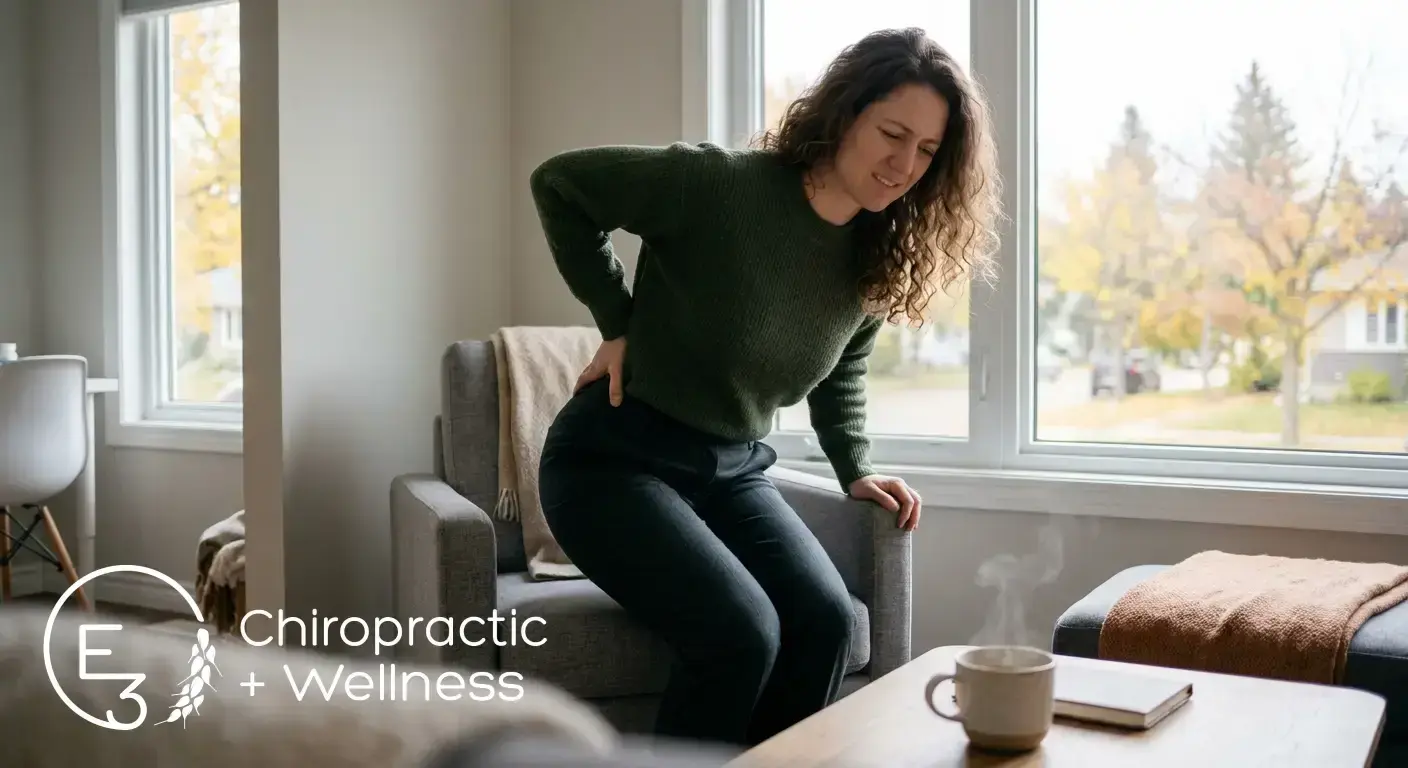
Have you ever stood up from your desk, gotten out of your car after driving across Saskatoon, or taken a long stride while walking, only to feel a sharp, stabbing pain deep inside your buttock?
Maybe it stays right in that one stubborn spot just above your hip pocket. Or perhaps it radiates down the back of your thigh, making you instantly question whether your sciatica is acting up again.
You try shifting your weight, rubbing the spot with a thumb, or stretching your hamstrings, but nothing seems to reach that deep, toothache-like throb.
If this sounds familiar, don't panic.
At E3 Chiropractic + Wellness, deep hip and buttock pain is one of the most common complaints we treat as the weather gets colder and daily routines shift indoors. And here is what surprises most people: while many assume any leg pain is automatically a herniated disc, the real culprit is very often the sacroiliac (SI) joint.
Let’s dive into what your SI joint actually does, why it gets irritated, and how we can get you sitting, standing, and walking comfortably again.
The "Train Track" Analogy
To understand why your SI joint causes such deep, nagging pain, let's look at how your upper body connects to your lower body.
Your pelvis is made up of two large hip bones that connect to your sacrum (the triangular bone at the base of your spine). The places where these bones meet are your sacroiliac joints. They don't swing like a door hinge; instead, they are heavy-duty shock absorbers built to transfer force between your spine and your legs.
Think of your pelvis like a set of train tracks.
When both sides of your tracks are perfectly aligned and level, the train glides smoothly across without any bumps or friction.
But what happens if one side of the track shifts just a couple of millimeters out of alignment—say, from sitting unevenly, slipping on a patch of ice, or carrying heavy bags on one side?
When the SI joint locks up or twists out of alignment, the smooth transfer of force breaks down. The surrounding ligaments get stretched tight, deep hip muscles (like your piriformis) lock into a protective spasm, and nearby nerves get irritated. Every single step you take feels like a train hitting a kinked rail.
SI Joint Dysfunction vs. Sciatica: What's the Difference?
Because the SI joint sits directly next to the sciatic nerve pathway, SI joint pain and classic sciatica often feel identical to the person experiencing them.
Here’s how they typically differ:
-
SI Joint Dysfunction: Pain is usually centered deep in one side of the buttock, right over the small dimple in your lower back. It often gets worse when standing on one leg, rolling over in bed, or stepping out of the car.
-
Classic Disc Sciatica: Pain usually originates in the center of the lower back and travels all the way down past the knee into the calf, ankle, or toes, often accompanied by numbness or pins-and-needles.
The good news? Whether your pain is coming from your SI joint, a lumbar disc, or a tight piriformis muscle, restoring proper pelvic alignment is key to resolving it.
How We Restore Pelvic Balance at E3 Chiropractic + Wellness
When your SI joint is locked out of its normal position, stretching a tight buttock muscle usually provides only temporary relief because the joint itself remains restricted underneath.
Here is how Dr. Layne and I at our Saskatoon clinic help you get lasting relief:
1. Accurate Movement & Pelvic Assessment
We thoroughly evaluate your pelvic symmetry, leg length balance, and hip rotation to confirm whether the pain is coming from your SI joint, lumbar spine, or deep gluteal tissues.
2. Precise Pelvic Adjustments
Targeted chiropractic adjustments gently restore normal alignment and gliding motion to the restricted SI joint. Realigning the joint instantly reduces mechanical tension on overstretched ligaments and nearby nerves.
3. Stabilizing the Core & Hips
Once the joint is moving freely again, we coach you through simple glute-activation and core-stabilization exercises so your body maintains its alignment naturally during daily movement.
3 Quick Steps to Relief SI Joint Pressure Today
If you're feeling a sharp pinch or deep ache in your hip or buttock right now, try these three practical steps:
-
Avoid Single-Leg Weight Standing: When waiting in line or talking to colleagues, avoid shifting all your weight onto one hip. Keep your weight distributed evenly across both feet to avoid twisting your pelvis.
-
The Figure-4 Seated Stretch: Sit upright in your chair, cross your affected ankle over your opposite knee, and gently lean your torso forward while keeping your spine straight. You should feel a smooth stretch deep in your glute. Hold for 30 seconds.
-
Keep Your Feet Flat While Sitting: Avoid crossing your legs at the knees or sitting on one foot, both of which force your SI joint into a rotated position for hours at a time.
Walk, Sit, and Move with Confidence Again
You don't have to push through deep hip pain or let a cranky SI joint ruin your daily walking, working, or exercise routines. Your pelvis is remarkable at re-aligning once given the right support, joint play, and muscle balance.
If deep buttock pain, hip stiffness, or shooting leg discomfort is holding you back, our team at E3 Chiropractic + Wellness is here to help you get clear answers.
When you’re ready, click HERE to book a discovery call with us today, and start getting some real answers.