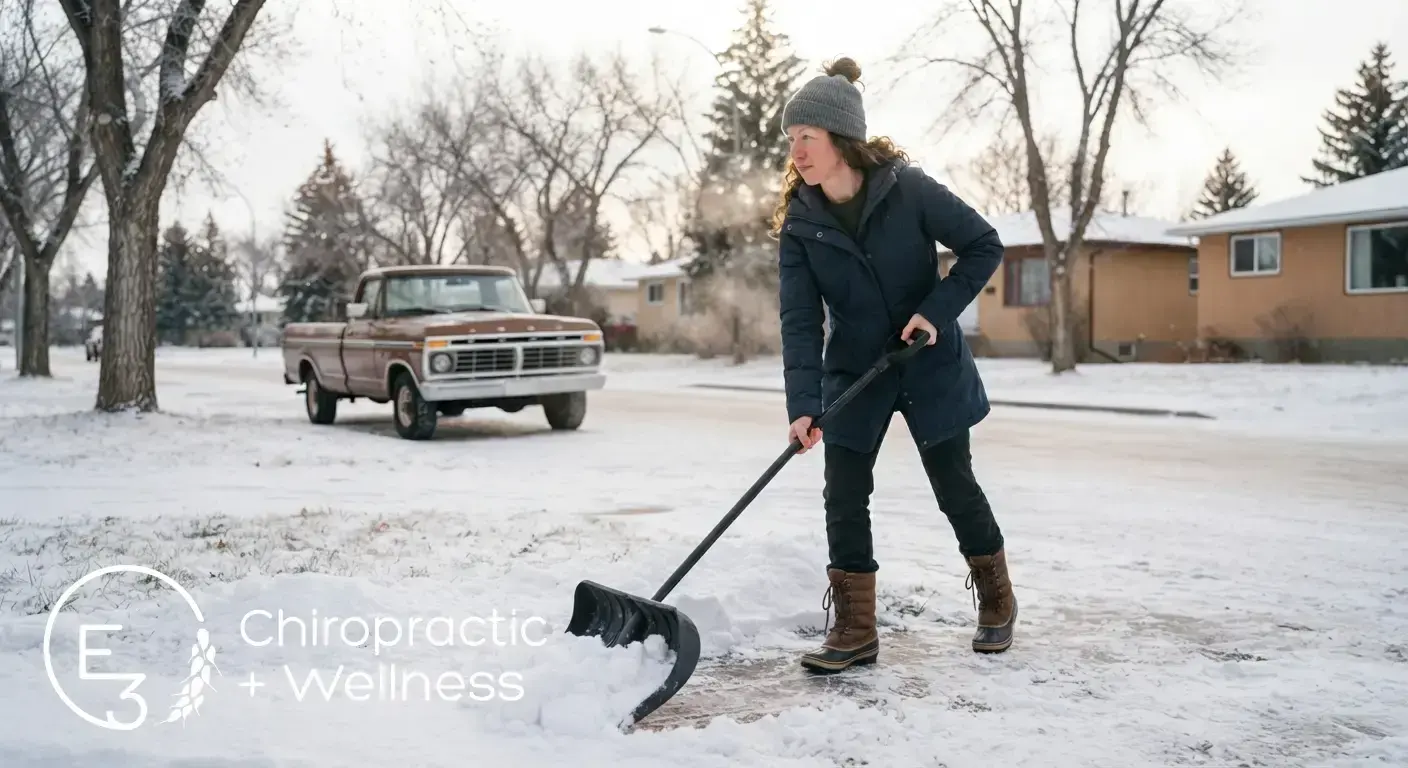
You wake up, pull back the curtains, and see a fresh blanket of snow covering your driveway and sidewalk.
You throw on your winter boots, grab a quick coffee, and head outside to clear the path before heading to work. Twenty minutes into scooping, lifting, and tossing heavy snow onto the lawn, you feel a sudden, sharp tug across your beltline—or a deep, stubborn stiffness that locks your lower back up by the time you step back inside.
If this sounds all too familiar, don't panic.
Every late November in Saskatoon, our doors at E3 Chiropractic + Wellness open to active, hardworking people who threw their backs out simply trying to keep their driveways clear. Snow shoveling is easily one of the most demanding full-body workouts you can do—yet most of us treat it like a quick morning chore without any preparation.
Let’s look at why snow shoveling is uniquely tough on your lower back, what’s actually happening inside your spine when you lift and twist, and how we can help you survive winter without ending up stuck on the couch.
The "Long Lever" Analogy
To understand why holding a shovel full of snow puts so much pressure on your lower back, imagine holding a 10-pound dumbbell.
If you hold that dumbbell tucked right against your chest, your arms and back barely notice the weight. Now, imagine holding that exact same 10-pound dumbbell straight out in front of you at arm's length. Within seconds, your shoulders shake, your core strains, and your lower back arches forcefully just to keep you from tipping forward.
A snow shovel acts like a long lever extending away from your body.
When you scoop up a shovel full of heavy, wet Saskatchewan snow—which can easily weigh 10 to 15 pounds per scoop—and hold it three feet out in front of you, leverage multiplies the load on your lower lumbar discs by up to ten times.
Now add in the classic "scoop, lift, and twist" motion—rotating your torso to throw snow over your shoulder while your spine is already bent forward under load. Bending and twisting at the exact same time places maximum shear force on your spinal discs and sacroiliac (SI) joints, causing your back muscles to lock into a painful protective spasm.
The Early-Morning Shoveling Trap
One of the biggest mistakes people make is stepping outside to shovel within 15 minutes of waking up.
While you sleep overnight, your spinal discs naturally absorb fluid, making them fuller, stiffer, and slightly more vulnerable to bending pressure first thing in the morning. Add in cold outdoor air that keeps your muscles tight, and rushing out to shovel before your body has warmed up is a recipe for an acute lower back flare-up.
How We Help You Recover at E3 Chiropractic + Wellness
If snow shoveling has already left your lower back stiff, pinched, or aching, resting on the couch for days rarely solves the underlying mechanical issue.
Here is how Dr. Layne and I at our Saskatoon clinic help you get back on your feet quickly:
1. Releasing Locked Spinal & Pelvic Joints
Repetitive bending and twisting often jams tiny joints in your lower back and pelvis. Precise chiropractic adjustments gently restore normal joint motion, taking physical pressure off irritated spinal discs and nearby nerves.
2. Calming Protective Muscle Spasms
When your lower back muscles lock up to guard an irritated joint, we use targeted hands-on care to calm the spasm down, restoring healthy blood flow and flexibility so you can stand upright comfortably.
3. Practical Movement & Lifting Coaching
We coach you through simple, real-world hip-hinging and core-bracing habits so you feel strong and confident tackling winter chores without fear of re-injuring your back.
3 Simple Rules for Pain-Free Snow Shoveling Today
Before the next big snowfall hits Saskatoon, keep these three simple, back-saving habits in mind:
-
Push, Don’t Lift: Whenever possible, use a wide pusher shovel to slide snow to the side of your driveway rather than scooping and lifting it. Keeping the blade on the ground eliminates lever strain completely.
-
Move Your Feet, Never Twist Your Spine: If you have to lift and toss snow, keep your hands spaced apart on the shaft for better leverage, hinge at your hips, and pivot your feet to face where you're throwing the snow instead of twisting your waist.
-
Wait 30 Minutes & Warm Up Inside: Give your spine at least 30 minutes after waking up before shoveling. Spend 3 to 5 minutes inside doing bodyweight squats, arm circles, and gentle walking to warm up your joint fluid and muscles before stepping into the cold.
Enjoy Winter Without Lower Back Pain
Winter in Saskatoon brings plenty of snow, and clearing your driveway shouldn't leave you sidelined with lower back pain for weeks at a time. Your spine is strong and resilient—it just needs smart lifting mechanics, a proper warm-up, and good joint alignment to handle the season safely.
If snow shoveling or lower back stiffness has left you feeling stuck or sore, our team at E3 Chiropractic + Wellness is here to help you get clear answers and lasting relief.
When you’re ready, click HERE to book a discovery call with us today, and start getting some real answers.