

Have you ever noticed that your body seems to have terrible timing?
Everything is going fine.
Then work gets busy.
The kids need more attention.
Your schedule fills up.
You start sleeping a little less.
And suddenly...
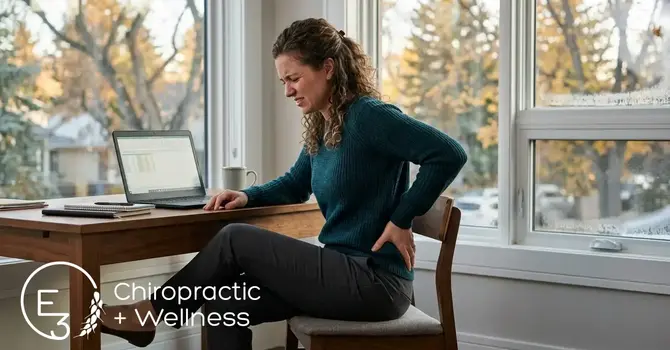
Your neck is tight.
Your lower back is aching.
Your shoulders feel like they're carrying the weight of the world.
You might even catch yourself thinking:
"Why does everything hurt when I'm stressed?"
Here's the thing.
It's not all in your head.
Stress can affect how your body feels, how you move, and how well you recover.
And when you combine stress with long hours sitting, poor sleep, and less movement, your body can start feeling the effects pretty quickly.
Your body doesn't separate stress from everything else
We often think of stress as something that happens in our minds. A deadline. A difficult conversation. A busy schedule. A long to-do list. But your body doesn't always make that same distinction. When you're stressed, your muscles can become more tense. You may breathe differently. You may clench your jaw. You might raise your shoulders without even realizing it. You may also spend more time sitting and less time moving. None of these things necessarily cause pain overnight. But when they happen day after day, they can add up.
Stress can change the way you move
Think about what happens when you're concentrating on something. Maybe you're working at your computer. Before you know it, your shoulders have crept toward your ears. Your head is leaning forward. Your jaw is clenched. You've been sitting in the same position for two hours. You didn't consciously decide to do any of that. Your body simply adapted to what you were asking it to do. Now imagine repeating that every day during a stressful month. It's no surprise that your neck and shoulders eventually start complaining.
Sleep matters too
When life gets busy, sleep is often one of the first things to suffer. You stay up later to finish something. You wake up earlier. Maybe your mind keeps running even after your head hits the pillow. Then you wake up tired and start the next day already behind. Your body doesn't get the same opportunity to recover. Over time, that can make everyday aches and stiffness feel harder to manage. It's a little like trying to drive your car without ever filling the tank. Eventually, something has to give.
Why pain can feel stronger during stressful periods
Here's an important point. Stress doesn't mean your pain isn't real. It can simply change how your nervous system responds to what's happening in your body. When you're already overwhelmed, your body may become more sensitive to things that normally wouldn't bother you as much. That's one reason an old injury or familiar ache can suddenly feel much more noticeable during a stressful period. The pain is real. Your circumstances may simply be turning up the volume.
A story you might relate to
One patient came into E3 Chiropractic + Wellness because their neck pain had suddenly become much worse. They couldn't understand it. They hadn't injured themselves. They hadn't changed their workouts. Nothing obvious had happened. But when we talked through the previous few weeks, there was a clear pattern. They had taken on a major project at work. They were working longer hours. They were sleeping less. They were spending more time at their computer. And they had stopped going for their usual evening walks. Their neck hadn't suddenly become "broken." Their entire routine had changed. Once they started getting more movement into their day, prioritizing recovery, and addressing how their body was moving, their symptoms became much easier to manage.
What can you do when life gets stressful?
You don't need to completely eliminate stress. Let's be realistic. That's probably not happening. Instead, focus on giving your body better ways to handle it.
1. Keep moving
When you're busy, movement can feel like one more thing on your list. But even a 10-minute walk can give your body a much-needed break from sitting and tension.
2. Change positions regularly
If you're working at a desk, don't wait until your neck hurts to move.
- Stand up.
- Walk around.
- Stretch.
- Change your position.
Your body likes variety.
3. Protect your sleep
You don't need a perfect nighttime routine. But consistently getting enough quality sleep gives your body a better chance to recover from the demands of the day.
4. Notice where you hold tension
- Do you clench your jaw?
- Raise your shoulders?
- Tighten your lower back?
Once you notice it, you can start catching yourself before that tension builds.
5. Don't ignore recurring pain
If your neck pain, lower back pain, headaches, or stiffness keeps returning every time life gets busy, don't simply assume that's your new normal.
Your body may be telling you that something needs more attention.
The bottom line
Life is going to get stressful. There will be busy weeks. Late nights. Deadlines. Family responsibilities. That's normal.
The goal isn't to create a life where you never experience stress. It's to build a body that can handle the ups and downs of everyday life without constantly feeling like it's running on empty. And if your pain seems to flare up every time your schedule gets hectic, that's worth paying attention to. Sometimes the first step toward pain relief isn't doing more. It's understanding what's putting your body under so much strain in the first place.
What to do next
If you've noticed that your lower back pain, neck pain, headaches, hip pain, or stiffness gets worse whenever life gets busy, you don't have to simply push through it.
At E3 Chiropractic + Wellness, Dr. Kurtis and Dr. Layne help people understand how their daily habits, movement, and physical demands may be contributing to recurring symptoms.
You don't need to have everything figured out before reaching out. When you're ready, click HERE to book a discovery call with us today, and start getting some real answers.


.jpg)
