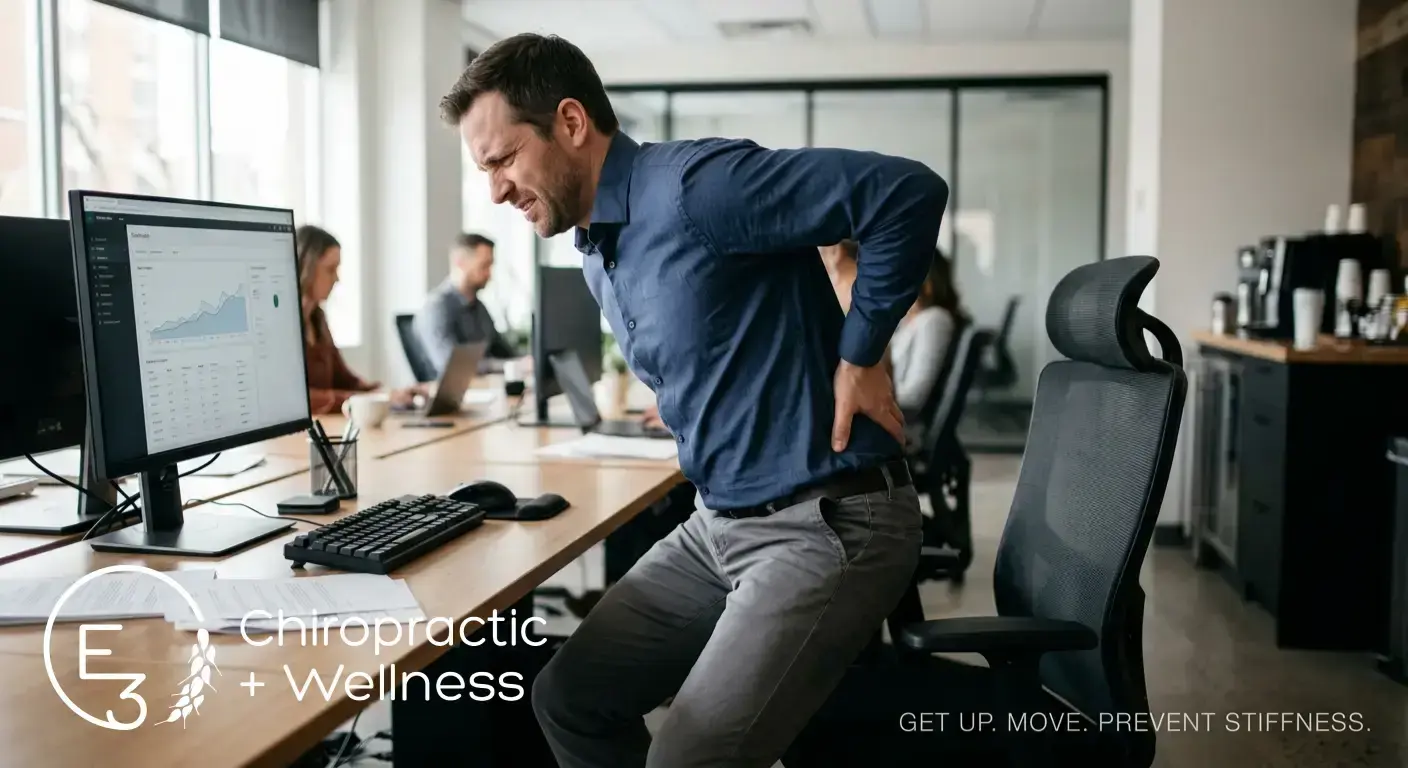
You know that feeling.
You've been sitting at your desk for a few hours.
You finally stand up and immediately think:"Why do I feel like I’m 80?"
Your lower back feels stiff.
Your hips don't want to move.
Your neck feels tight.
And those first few steps feel more like you're trying to convince your body to cooperate than simply walking across the room.
Then, after a few minutes of moving around, things start to loosen up.
Sound familiar?
Here's the thing.
Your body wasn't designed to stay in one position for hours at a time.
And if you're dealing with recurring lower back pain, neck pain, hip stiffness, or everyday aches, your workday may be contributing more than you realize.
Sitting isn't necessarily the problem
Let's clear something up first. Sitting isn't bad. You don't need to throw away your office chair or quit your desk job. The bigger issue is staying in the same position for too long. Your body likes movement and variety. Think about it like this. Imagine wearing the same pair of shoes every single day. Eventually, one part of the shoe starts to take more wear than another. Your body can experience something similar when you're constantly sitting in the same position. Certain muscles and joints are doing very little. Others are working to keep you in that position. Over several hours, that can leave you feeling stiff and uncomfortable.
Your body adapts to what you do most
This is one of the most important things to understand about pain. Your body is always adapting. If you spend eight hours a day sitting, your body becomes very good at sitting. But that doesn't necessarily mean it becomes better at everything else. Then you finish work and try to go for a run, hit the gym, play hockey, or work in the yard. That's a pretty big jump. You've gone from spending most of the day in one position to asking your body to suddenly do a lot more. For some people, that's when the aches start showing up.
Your hips and lower back often get caught in the middle
When you're sitting, your hips stay in a relatively fixed position for a long time. Your lower back does too. Now imagine doing that every day. Monday. Tuesday. Wednesday. Thursday. Friday. Then you finally get to the weekend and decide you're going to make up for it. You go for a long hike. Play 18 holes. Work in the yard for five hours. Or spend the entire Saturday doing house projects. Your body may not be ready for that sudden change in demand. That doesn't mean you're fragile. It means your body likes consistency.
The same thing can happen to your neck
If you work at a computer, you've probably caught yourself doing this. You start the morning sitting upright. By 10:30, your head is creeping toward the screen.By lunch, your shoulders are rounded. By 3:00, you're rubbing your neck and wondering why you have a headache. Sound familiar? Your body isn't necessarily "broken." It's responding to the position you've been asking it to hold for hours. The longer you stay there, the more noticeable that tension can become.
Why standing up can feel so good
Have you ever stood up after sitting for a long time and immediately felt like you needed to stretch? That's your body asking for movement. Once you start walking around, your joints begin moving again. Your muscles start working differently. Your circulation changes. Your nervous system gets different information. And often, that stiffness starts to settle down. That's why one of the simplest things you can do during a long workday is also one of the easiest to overlook: Get up and move.
A story you might relate to
One patient came into E3 Chiropractic + Wellness because their lower back was stiff every afternoon. They'd wake up feeling pretty good. They could get through their morning without much trouble. But by 3 or 4 PM, their back felt tight and uncomfortable. They assumed something was wrong with their lower back. But when we talked through their day, a pattern became obvious. They were sitting at a desk for most of the day. They rarely took breaks. They ate lunch at their computer. Then, after work, they often went straight to the gym. Their body was spending most of the day barely moving and then being asked to perform. Once they started adding more movement throughout the workday and we addressed the areas that weren't moving as well, their afternoons became much easier. The goal wasn't to tell them to stop exercising. It was to help their body handle the demands they were putting on it.
You don't need a perfect workstation
It's easy to get caught up in finding the "perfect" chair, desk, keyboard, or posture. Those things can certainly matter.But here's something I want you to remember: There is no perfect position if you stay in it for eight hours. You could have the world's best ergonomic chair. If you never get out of it, your body is still spending a huge amount of time in one position. Instead of obsessing over perfect posture, think about changing positions regularly.
- Sit
- Stand
- Walk
- Stretch
- Move around
- Then sit again
Your body doesn't need perfection. It needs variety.
What can you do during your workday?
You don't need to completely redesign your life. Start small.
1. Get up regularly
Set a reminder if you need one. Stand up. Walk to get some water. Go talk to someone instead of sending another message. Take a quick lap around the office. A few minutes of movement can break up a long period of sitting.
2. Move before you're stiff
Don't wait until your back hurts before getting up. If you know you've been sitting for a while, that's your cue to move. Prevention doesn't have to be complicated. Sometimes it's simply getting out of the chair.
3. Look at your entire day
Ask yourself:
- How much of my day do I spend sitting?
- How often do I move?
- Do I exercise after sitting for eight hours?
- Do I spend my evenings on the couch?
The bigger picture matters.
4. Don't ignore recurring stiffness
If your back or neck feels stiff once in a while after a long day, don't panic. But if it's happening every day, it's worth understanding why. Recurring symptoms are your body's way of getting your attention.
What if you've already tried everything?
Maybe you've bought the standing desk. You've upgraded your chair. You've stretched every morning. You've tried heat. You've tried massage. Maybe you've even had an adjustment. And yet the same stiffness keeps coming back. That's when it's worth stepping back and asking a different question.
Not: "What can I do to make this feel better today?"
But:"Why does my body keep responding this way?"
That's where a proper assessment can be helpful. Instead of simply chasing the uncomfortable area, we want to understand how your body is moving as a whole and what might be contributing to the problem.
The bottom line
If you spend most of your day sitting, it's completely understandable that your body may feel stiff when you finally get up. That doesn't automatically mean something is seriously wrong.
But if lower back pain, neck pain, hip stiffness, or headaches are becoming part of your everyday routine, don't just accept them as the price of having a desk job.Your body is adaptable.
And small changes in how often you move, how you recover, and how you approach your daily demands can make a meaningful difference. You don't need to spend less time living your life.You may simply need to give your body more opportunities to move while you're living it.
What to do next
If you're tired of finishing every workday with a stiff back, tight neck, or aching hips, you don't have to keep guessing what's going on.
At E3 Chiropractic + Wellness, Dr. Kurtis and Dr. Layne take the time to understand how your body moves, what your daily routine looks like, and what you actually want to get back to doing.The goal isn't just temporary pain relief.
It's helping you understand your body and build a plan that fits your life. When you're ready, click HERE to book a discovery call with us today, and start getting some real answers.