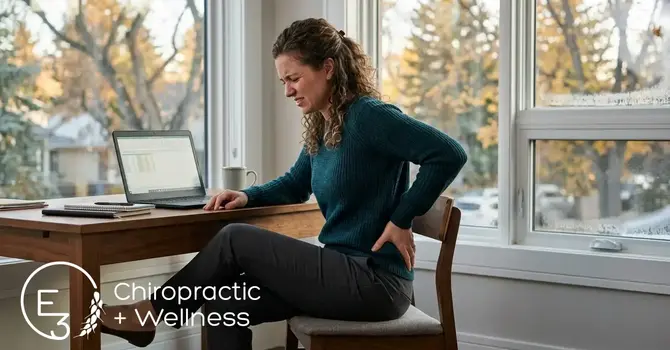
You stand up from your desk and immediately feel it.
Your hips are stiff. Your lower back feels tight. Your neck feels locked up.
Maybe you even make that little “ugh” noise getting out of your chair.
At first, you laugh it off.
“I guess I’m getting old.”
But over time, it starts happening more often.
Long drives feel worse. Workdays feel harder. Workouts feel stiff and awkward.
And now you’re wondering:
“Why does sitting affect me this much?” “Should my body really feel this tight?” “Is something wrong with me?”
If that sounds familiar, you’re definitely not alone.
At E3 Chiropractic + Wellness, we hear this every single week.
And here’s the thing.
Your body was built to move.
So when you spend most of the day sitting, your body adapts to that position.
That adaptation is usually what you’re feeling.
Sitting itself isn’t evil
Let’s clear this up first.
Sitting is not automatically bad.
The problem is usually how long we stay there.
Your body handles positions well.
It struggles with staying in the same position for hours and hours.
Think about your body like a sponge.
If you leave a sponge folded in the same position long enough, it stiffens into that shape.
Your muscles and joints respond similarly.
The longer you stay in one position, the more your body adapts around it.
Why your hips and lower back feel it the most
This is one of the biggest patterns we see.
When you sit for long periods:
- Your hips stay bent
- Your glutes become less active
- Your core does less work
- Your upper back rounds forward
Over time, your body starts relying on the same muscles and joints over and over.
That creates tension. Stiffness. Compensation.
Then, when you finally stand up, your body has to suddenly transition back into movement.
That’s why people often feel:
- Tight hips
- Achy lower backs
- Stiff hamstrings
- Neck and shoulder tension
Especially after long workdays.
Why you loosen up once you start moving
This is another huge clue.
A lot of people say:
“I feel terrible when I first stand up… but better after I move around.”
That’s because movement helps redistribute load through the body.
Your joints start moving again. Your muscles warm up. Your nervous system relaxes.
Movement is often the thing your body has been missing all day.
But if you return right back to sitting for another several hours, the cycle repeats.
Your workouts can be affected too
This surprises people.
A lot of active adults stretch before workouts because they feel stiff.
But the stiffness didn’t start during the workout.
It often started from how their body spent the previous 8 to 10 hours.
If your hips and upper back barely move all day, your body doesn’t magically reset the second you walk into the gym.
That’s why people often feel:
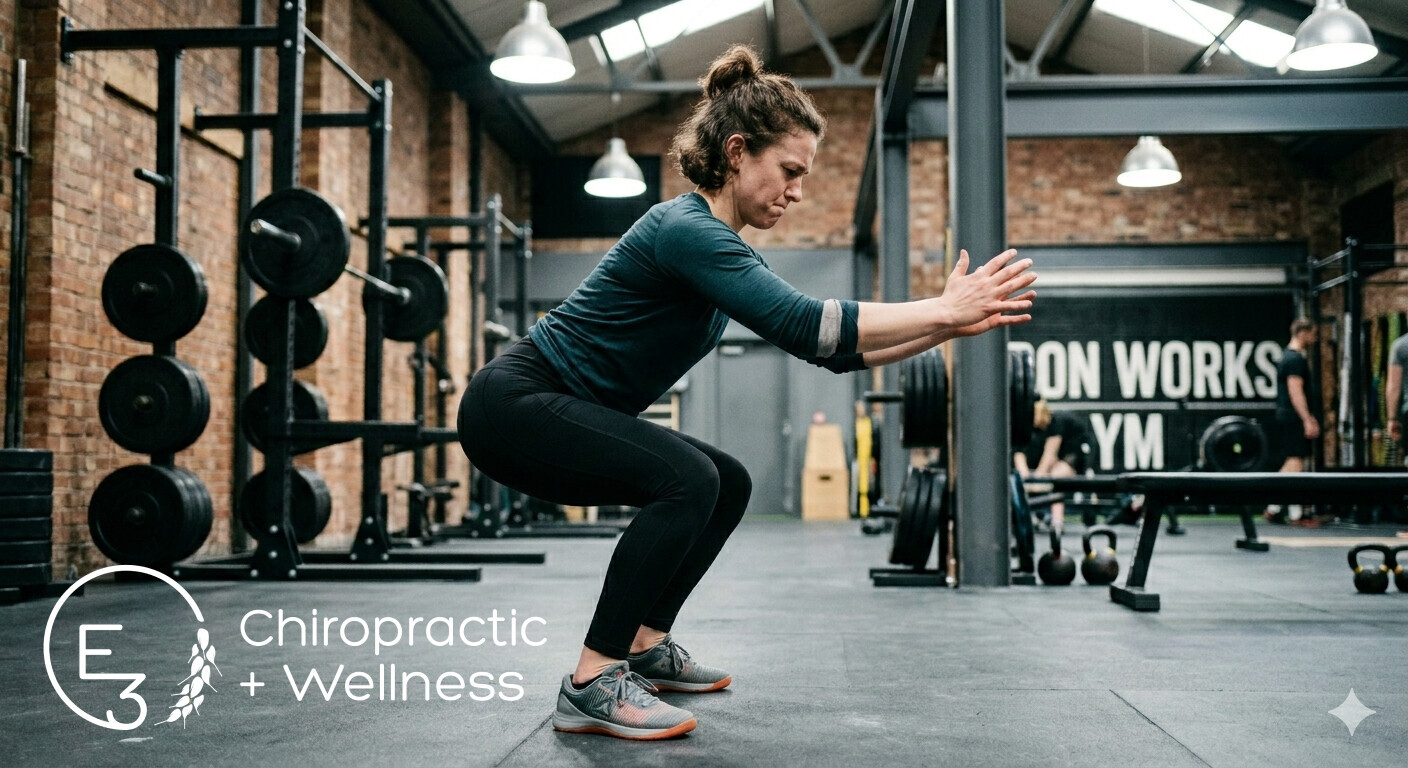
- Tight during squats
- Limited overhead mobility
- Lower back tension during lifts
- Stiffness while running
Your body carries the stress of your daily habits into your workouts.
A quick story you might relate to
One patient came into the clinic saying:
“I work out regularly, so I don’t understand why my body still feels so stiff.”
They exercised several times a week.
But they also sat at a desk for nearly 10 hours every day.
By the end of each workday, their hips and lower back felt incredibly tight.
And eventually that stiffness started affecting their workouts too.
When we assessed how they moved, it wasn’t just about “tight muscles.”
Their hips weren’t moving well, their core wasn’t supporting movement efficiently, and their lower back had been compensating for a long time.
Once we addressed the movement issues underneath and gave them a plan that fit their daily life, things started changing.
Less stiffness. Better workouts. Less lower back tension. More energy.
Most importantly?
They stopped feeling like their body was constantly fighting against them.
Why stretching only helps temporarily
Stretching can feel great.
But if your body keeps returning to the same positions and movement patterns every day, the tightness usually comes back.
Because the body is adapting to how you use it most.
This is why so many people say:
“I stretch constantly but still feel tight.”
The body often needs more than temporary stretching.
It usually needs:
- Better movement throughout the day
- Improved strength and stability
- Better joint mobility
- Less time staying still
- More balanced movement patterns
What actually helps long-term
At E3 Chiropractic + Wellness, we look beyond the tightness itself.
Dr. Kurtis, Dr. Zach, and Dr. Layne focus on understanding why your body keeps creating stiffness and compensation.
That means looking at:
- Hip mobility
- Core stability
- Upper back movement
- Daily positioning
- Strength and movement patterns
- How your body handles load throughout the day
Because your body works as a system.
And often, the place that feels tight is only part of the story.
What you can start doing right now
If your body feels tight after sitting all day, here are a few simple places to start.
1. Move more often throughout the day
This matters more than people realize.
Even standing up and walking for a couple minutes every hour helps.
Your body likes variety.
2. Don’t rely only on stretching
Stretching helps symptoms.
But long-term changes usually require improving how your body moves and supports itself overall.
3. Pay attention to how long you stay still
Most bodies tolerate sitting much better when movement is mixed throughout the day.
Small movement breaks add up.
4. Stop assuming stiffness is “just aging”
A lot of stiffness is simply adaptation.
And your body can adapt positively too.
That’s the encouraging part.
The bottom line
If everything feels tight after sitting all day, your body is probably responding exactly how it was designed to.
The problem usually isn’t that your body is broken.
It’s that your body has adapted to long periods of stillness.
And once you understand that, you can start changing the cycle.
What to do next
If you’re tired of feeling stiff after every workday, struggling through workouts, or constantly fighting tight hips and lower back tension, you don’t have to keep guessing.
At E3 Chiropractic + Wellness, Dr. Kurtis, Dr. Zach, and Dr. Layne help people every day understand what their body actually needs to move and feel better long-term.
We’ll help you build a plan that makes sense for your body, your goals, and your daily life.
When you’re ready, click HERE to book a discovery call with us today, and start getting some real answers.