
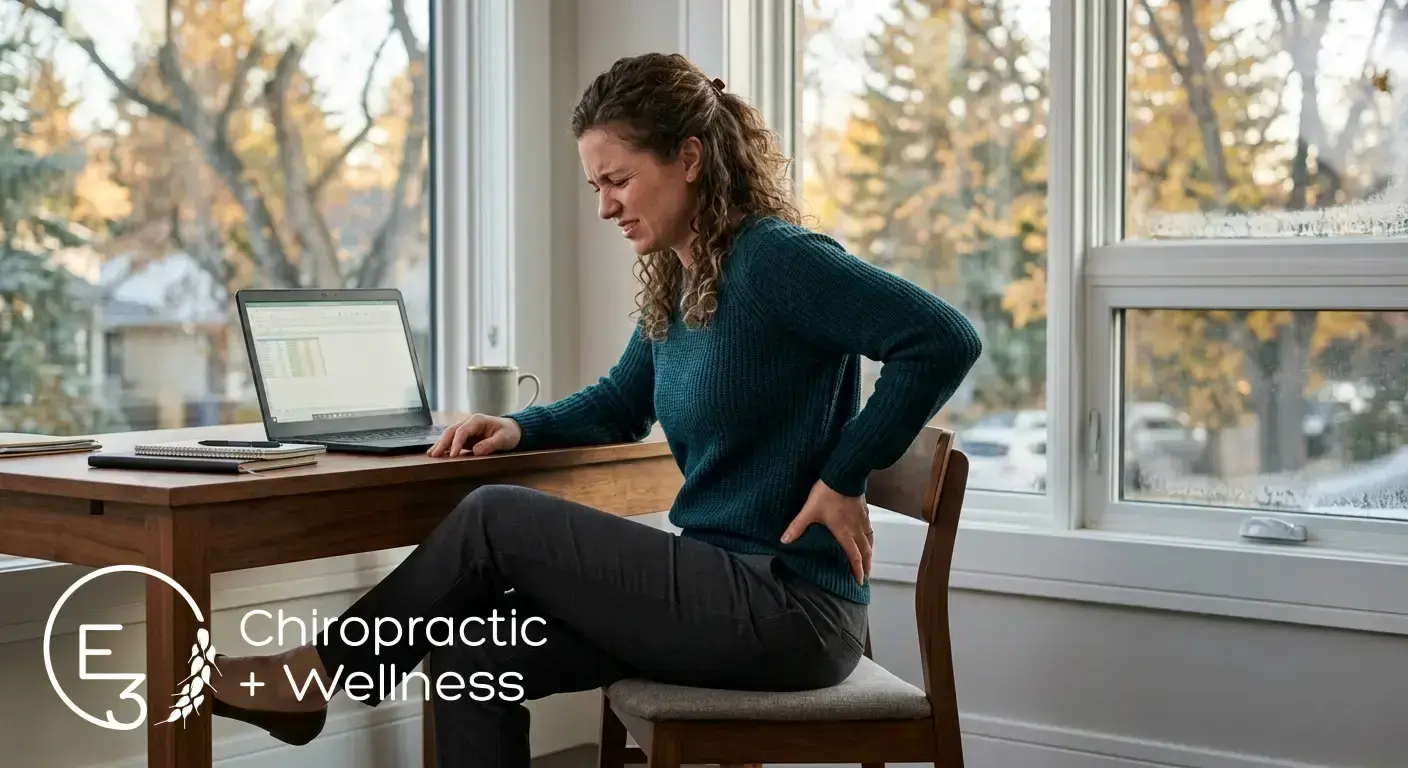
It usually starts while sitting at your desk finishing up an afternoon project, or halfway through a drive across Saskatoon.
You feel a dull, stubborn ache creeping into your lower back or deep inside your hip. But as you stay seated, it changes. Suddenly, a sharp, burning pain, tingling sensation, or weird numbness starts traveling down into your buttock, hamstring, calf, or even your foot.
You shift your weight to one side, try leaning back, or slide a hand under your hip, but no matter how you sit, you just can't find a comfortable spot.
If this happens to you every time you sit down for more than twenty minutes, don't panic.
Sciatica can be intense, alarming, and deeply frustrating, but it is also one of the most common conditions we treat at E3 Chiropractic + Wellness. And as autumn settles in and we all start spending more time sitting indoors, at desks, or on the couch, sciatica flare-ups become extremely common.
Let's look at why sitting puts so much pressure on your nerve, what’s actually happening inside your body, and how we can get you sitting and moving comfortably again.
The "Garden Hose" Analogy
Your sciatic nerve is the thickest and longest nerve in your body. It originates in your lower spine, passes deep through your pelvis and hips, and travels all the way down the back of each leg to your feet.
To understand why sitting makes it hurt, think of your sciatic nerve like a garden hose.
When a hose is lying straight on the lawn, water flows through smoothly and effortlessly. But what happens if you step directly on the hose or press it against a sharp corner? The water flow gets blocked, pressure builds up behind the kink, and the hose swells.
Sitting down naturally flexes your lower spine and compresses your gluteal muscles. If the joints in your lower back or pelvis are restricted, or if deep hip muscles (like your piriformis) are tight from sitting, the "hose" gets pinched.
The pain you feel in your calf or foot isn't actually an injury in your leg—it's just a warning signal reaching your brain because the hose is getting squished back at your spine or hip.
Why Sitting Is the Ultimate Sciatica Trigger
Sitting down might feel like rest, but mechanically, it places a unique set of demands on your lower spine and nerve pathways:
-
Increased Disc Pressure: Sitting rounded in a chair places up to 40% more pressure on your lumbar discs than standing upright. If a disc is slightly bulged or inflamed, that extra seated pressure pushes it directly toward the sciatic nerve root.
-
Tight Piriformis & Deep Hip Muscles: The sciatic nerve runs right beneath (and sometimes directly through) the piriformis muscle deep in your buttock. Hours of sitting compress this muscle, causing it to spasm and clamp down on the nerve.
-
Inflexible Hamstrings: Sitting with your knees bent at 90 degrees keeps your hamstrings in a shortened position. When you stand up, tight hamstrings pull downward on your pelvis, locking your lower back in a flattened, irritated state.
How We Relief Sciatica Pressure at E3 Chiropractic + Wellness
Taking pain medication can temporarily numb the warning signal, but if the mechanical pressure on the nerve remains every time you sit down, the pain will keep coming back.
When you come see Dr. Zach, Dr. Layne, or myself at our Saskatoon clinic, our focus is on finding the exact spot where the hose is kinked and relieving that pressure safely:
1. Identifying the Source of Compression
Sciatica is a symptom, not a final diagnosis. We perform a thorough movement assessment to see whether the nerve pressure is coming from your lower lumbar spine, your SI joints, or deep hip muscles.
2. Precise Joint & Pelvic Adjustments
Targeted chiropractic adjustments restore proper alignment and movement to restricted joints in your lower back and pelvis. Taking mechanical stress off the joint opens up physical space around the nerve root, calming the alarm system down.
3. Active Care & Nerve Glides
We teach you gentle, effective movement habits—like nerve flossing and hip mobility drills—that encourage your sciatic nerve to slide freely through surrounding tissues without getting caught when you sit or bend.
3 Quick Steps to Ease Sciatica Pain While Sitting Today
If sitting down is triggering your leg pain today, try these three simple, practical adjustments:
-
Sit on Your "Sit Bones," Not Your Tailbone: Avoid slouching back onto your tailbone, which rounds your lower spine and maximizes nerve compression. Sit upright on your ischial tuberosities (sit bones) with your feet flat on the floor.
-
The 20-Minute Rule: Set a timer on your phone. Every 20 to 30 minutes, stand up for just 30 seconds, take a few steps, or gently arch your lower back to give your spinal discs and nerve a break.
-
Use a Lumbar Roll: Place a rolled-up towel or small cushion behind the curve of your lower back while driving or working at your desk to help preserve your natural spinal curve and reduce nerve pressure.
Get Back to Sitting and Living Without Fear
Sciatica can make simple everyday moments—like driving to work, enjoying dinner, or relaxing on the weekend—feel miserable. But your nerve is remarkably resilient, and once we take the physical pressure off the source, relief can happen much faster than you think.
If you’re tired of shooting leg pain, lower back tightness, or hip discomfort every time you sit down, our team at E3 Chiropractic + Wellness is here to help you get real, lasting answers.
When you’re ready, click HERE to book a discovery call with us today, and start getting some real answers.

.jpg)
.jpg)
