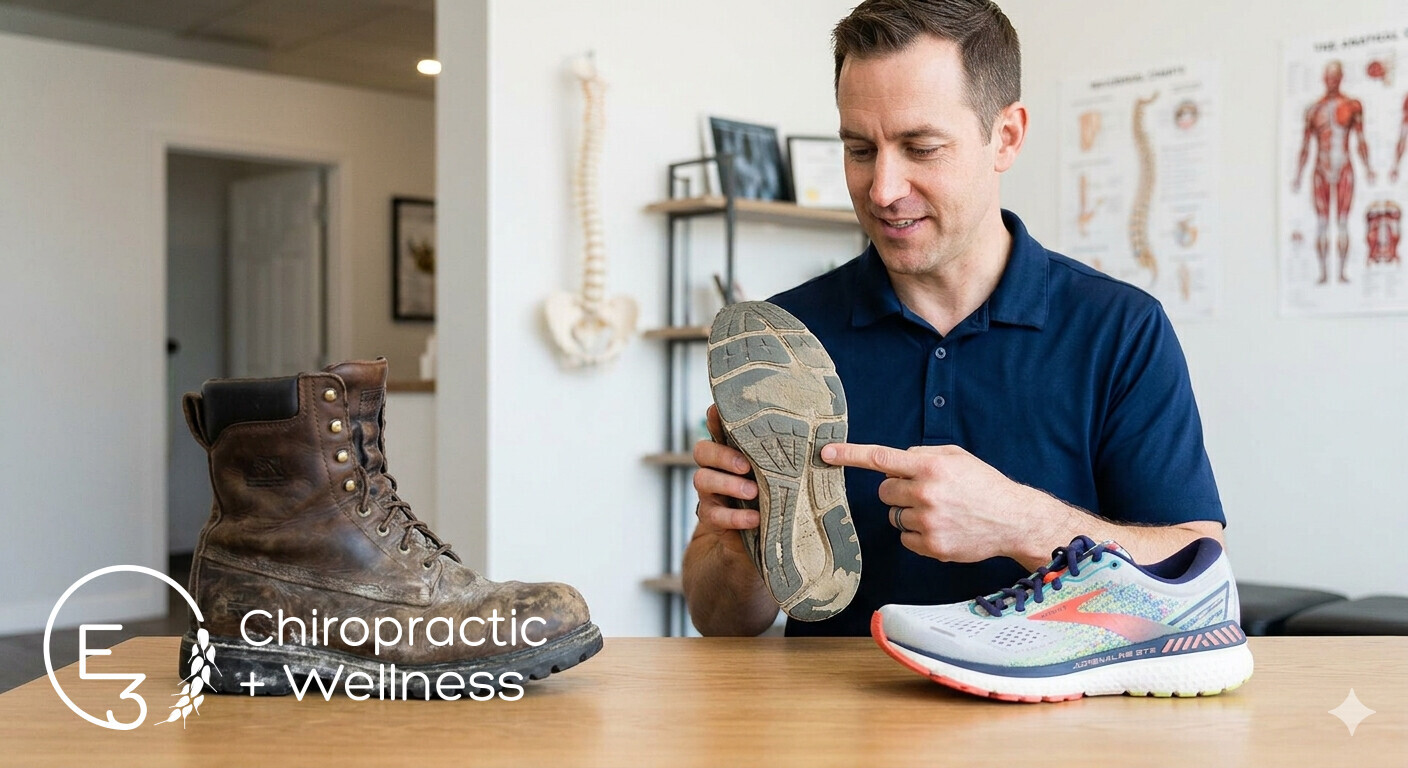
The Great Saskatoon Shoe Swap
It is a ritual every April in Saskatoon. We finally move our heavy, salt-stained winter boots to the back of the closet and pull out our runners, loafers, and light sneakers. After five months of navigating icy snowbanks in rigid, high-traction footwear, our feet are suddenly "liberated."
However, at E3 Chiropractic + Wellness, we notice a distinct spike in "foundation-based" injuries every year during this transition. Patients walk into the clinic with sudden bouts of plantar fasciitis, nagging shin splints, or new lower back pain that seemingly appeared out of thin air. The culprit isn't usually a single event; it is the Great Shoe Swap.
Moving from a high-stability boot to a flat, unsupportive sneaker—or worse, an old pair of runners with 600 kilometers of "dead foam"—shocks your nervous system and alters your entire kinetic chain.
The Foot: Your Body’s First Point of Contact
Your foot is a masterpiece of biological engineering. It contains 26 bones, 33 joints, and over 100 muscles, tendons, and ligaments. It is your body’s only point of contact with the ground. Every time you take a step on the Meewasin Trail, your foot must perform two contradictory jobs:
- The Mobile Adapter: Upon impact, the foot must be flexible enough to absorb the shock of the pavement.
- The Rigid Lever: A split second later, it must become stiff enough to propel your entire body weight forward.
When you spend all winter in heavy boots, your "Foot Core"—the small intrinsic muscles that support your arch—often becomes "lazy." The boot provides all the stability, so your muscles stop firing. When you suddenly switch to a light runner or a flat casual shoe, your feet aren't prepared for the workload. This lack of stability migrates up the chain: your knees collapse inward (valgus stress), and your lower back over-compensates to keep you upright.
The "Old Runner" Trap
Many Saskatoon residents pull out their running shoes from last spring and assume they are ready for the season. But here is a clinical secret: the foam in a running shoe has a shelf life.
Most modern midsoles are made of Ethylene Vinyl Acetate (EVA). This material is designed to compress and rebound, but after 400 to 600 kilometers, it loses its "spring." Even if the tread on the bottom looks perfectly fine, the internal cushioning is likely "dead".
Running or walking on dead foam increases the ground reaction force on your shins, knees, and hips by nearly 25%. Before you start your April training, Dr. Kurtis, Dr. Zach, and Dr. Layne recommend the "Squeeze Test." If the midsole feels brittle or if you can easily fold the shoe in half, it’s time for an upgrade. Your foundation is worth the investment.
Building a "Foot Core" Blueprint
At E3, we don't just treat the spot where it hurts; we look at how you stand. During an Annual Audit, we perform a comprehensive gait analysis. We look for:
- Big Toe Mobility: If your big toe doesn't "windlass" (flex) correctly, your arch will collapse.
- Ankle Dorsiflexion: If your ankle is "locked" from winter boots, your body will find that missing motion in your lower back.
- Arch Control: We assess whether your "Foot Core" is active or "hibernating."
If your foundation is weak, your 90-Day Blueprint will include specific drills to wake up those muscles. We move beyond "orthotics-as-a-crutch" and focus on building a foot that can support itself. By strengthening your base, we ensure that the adjustments we make to your spine actually "stick" because they aren't being undone by a collapsing foundation.
Self-Care Starts from the Ground Up
True self-care is about paying attention to the details that others ignore. Choosing the right footwear and maintaining your "Foot Core" is a high-performance habit. It is the difference between finishing a family walk along the river feeling refreshed or finishing it with a "whisper" of heel pain that could sideline you for the entire summer.
We want you to have the "Presence Capacity" to enjoy the spring weather with your loved ones without being distracted by foot or back pain. Taking care of your foundation is a selfless act that keeps you active, engaged, and "Saskatoon Strong".
Efficiency for the Active Professional
We know that in April, your to-do list is growing along with the grass. You want to spend your time outdoors, not in a waiting room. To support your active lifestyle, we have fully transitioned to Front-End Billing.
Important Note: We now process your payment at the beginning of your appointment.
This allows your session with Dr. Kurtis, Dr. Zach, or Dr. Layne to be 100% focused on your clinical care and coaching. Once the treatment is done and your gait has been checked, you can walk straight out the door. We value your time and want to get you back on your (newly supported) feet as quickly as possible.
Don’t Build on a Weak Foundation
If you have noticed new aches in your knees or lower back since putting away your winter boots, do not wait for them to become a "scream". Your feet are trying to tell you something about your foundation.
Click HERE to book a discovery call with us today. Let’s audit your gait, check your footwear, and ensure your foundation is ready for a high-performing spring!
___________________________________________________________
Disclaimer: The information in this article is for educational purposes only. Always consult a professional at E3 Chiropractic + Wellness for a personalized diagnosis and treatment plan.

.jpg)
.jpg)