
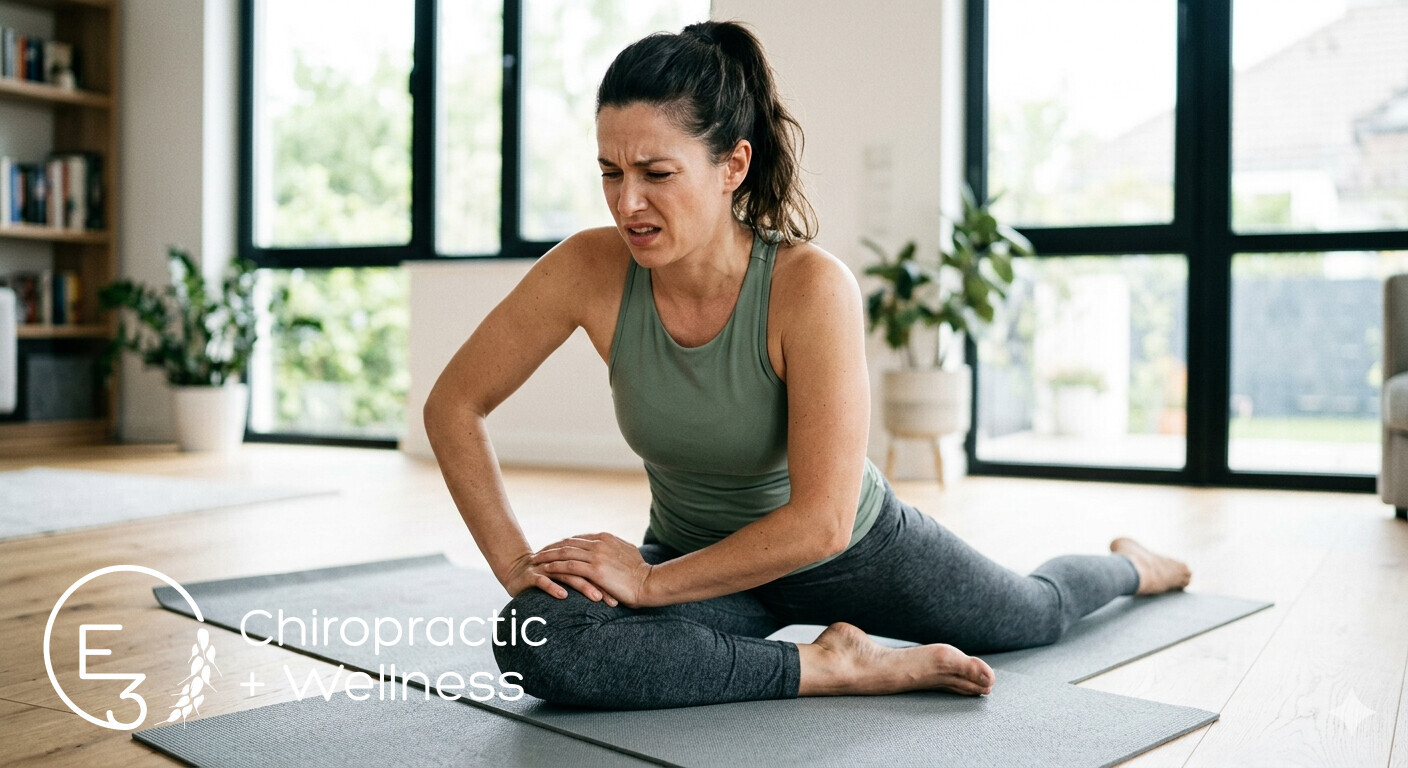
You stretch your hips constantly.
Before workouts. After workouts. Before bed. Sometimes even in the middle of the day.
And for a few minutes?
Things feel better.
But then the tightness comes right back.
Your hips still feel stiff getting out of the car. Your lower back still feels tight after sitting. Your squats still don’t feel smooth.
Now you’re wondering:
“Am I just naturally tight?” “Do I need to stretch more?” “Why does this never fully go away?”
If that sounds familiar, you’re definitely not alone.
At E3 Chiropractic + Wellness, we hear this all the time.
And here’s the thing.
Tight muscles are not always the actual problem.
Sometimes your body is creating tightness for a reason.
So why do your hips keep feeling tight?
Let’s simplify this.
Your body loves stability.
If something feels weak, unstable, or unsupported, your body often responds by creating tension.
Think of tightness like your body pulling the emergency brake.
It’s trying to protect you.
That means stretching the area over and over may only give temporary relief if the real issue underneath never changes.
Tight hips are often connected to how you move all day
This is one of the biggest patterns we see.
A lot of people spend most of their day:
- Sitting at a desk
- Driving
- Looking at screens
- Barely moving between long periods of sitting
Over time, your body adapts.
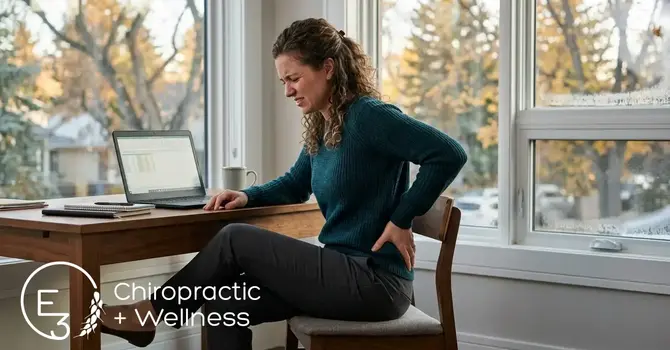
Your hips stop moving as well. Your muscles become less active. Your lower back starts compensating.
And eventually, your body starts feeling stiff and tight all the time.
Not because your body is “broken.”
Because it adapts to the positions and stress you repeatedly put it in.
Why stretching alone usually doesn’t solve it
Stretching can absolutely help.
But here’s what most people miss.
If your body feels unstable, it will keep recreating tension.
It’s like trying to loosen a knot while someone else keeps pulling it tighter.
This is why people often say:
“I stretch every day, but my hips are still tight.”
Because the body is protecting something.
Sometimes the issue is:
- Weakness
- Poor movement control
- Limited joint mobility
- Compensation from another area
- Lack of stability through the core or hips
And until those things improve, the tightness keeps returning.
Your lower back might be involved too
This is a huge connection.
When the hips stop moving well, the lower back often takes over.
Your body still needs to bend, twist, squat, and move somehow.
So if your hips aren’t contributing enough, your lower back usually picks up the extra workload.
That’s why so many people deal with:
- Tight hips
- Achy lower backs
- Stiffness after sitting
- Discomfort during workouts
All at the same time.
Your body works as a system.
Rarely is it just one isolated area.
A quick story you might relate to
One patient came into the clinic saying:
“I feel like I spend half my life stretching my hips.”
They had tried yoga videos, mobility routines, foam rolling… all of it.
But their hips always tightened right back up.
Especially after sitting or working long days.
When we assessed how they moved, the problem wasn’t simply “tight muscles.”
Their hips lacked stability and their lower back had been compensating for a long time.
Their body was using tension as protection.
Once we addressed the movement issues underneath and gave them a plan that actually matched what their body needed, things started changing.
Less stiffness. Better workouts. Less lower back tension.
Most importantly?
They stopped feeling like they had to constantly fight their body.
“Am I just getting older?”
We hear this question constantly.
And honestly, it’s understandable.
A lot of people assume stiffness automatically comes with age.
But here’s what we want people to know.
Your body responds to how you move and load it over time.
We see people in their 50s moving incredibly well.
And we see people in their 20s who feel stiff all the time.
Age matters less than people think.
Movement habits, strength, recovery, stress, and daily positioning usually play a much bigger role.
What actually helps long-term
At E3 Chiropractic + Wellness, we don’t just chase the feeling of tightness.
We look at why your body keeps creating it.
That means Dr. Kurtis, Dr. Zach, and Dr. Layne focus on things like:
- Hip mobility
- Core stability
- Movement patterns
- Joint function
- Lower back compensation
- Strength and control
- Daily habits and positioning
Because your body is connected.
And often, the place that feels tight is only part of the story.
What you can start doing right now
If your hips constantly feel tight, here are a few simple places to start.
1. Move more throughout the day
Your body was built to move.
Long periods of sitting tend to make hip stiffness worse.
Even short movement breaks help.
2. Stop assuming stretching is the only answer
Stretching helps relieve symptoms.
But if tightness keeps returning, your body may need more support, stability, and strength.
3. Pay attention to patterns
When do your hips feel worst?
- After sitting?
- During workouts?
- First thing in the morning?
Your body is giving you clues.
4. Focus on the root cause
Temporary relief is great.
But if your body keeps ending up in the same cycle, it’s worth figuring out why.
That’s where long-term progress happens.
The bottom line
If your hips always feel tight, your body is probably trying to tell you something.
And more stretching alone usually isn’t the full answer.
When you understand why your body keeps creating tension, you can finally stop chasing temporary relief and start making real progress.
What to do next
If you’re tired of constantly stretching, feeling stiff, or dealing with tight hips that never seem to improve, you don’t have to keep guessing.
At E3 Chiropractic + Wellness, Dr. Kurtis, Dr. Zach, and Dr. Layne help people every day who feel stuck in this exact cycle.
We’ll help you understand what’s actually going on and build a plan that makes sense for your body and your goals.
When you’re ready, click HERE to book a discovery call with us today, and start getting some real answers.

.jpg)
