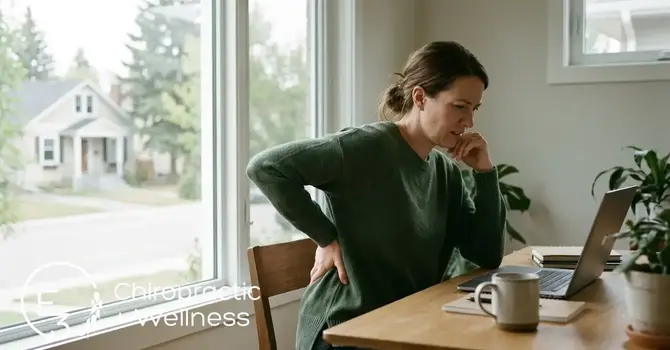
It usually starts small.
A little stiffness in your neck after work.
A sore lower back when you get out of the car.
A tight hip that seems to loosen up after you walk around.
Nothing major.
So you tell yourself:
"It's probably nothing."
"I just slept funny."
"I'll stretch it out."
And honestly, sometimes that works.
But sometimes those little aches and pains keep showing up.
Not enough to stop you from living your life.
Just enough to be annoying.
Then one day, seemingly out of nowhere, your back locks up.
Or your neck won't turn.
Or that little ache you've ignored for months suddenly becomes the thing that keeps you from doing what you enjoy.
Now you're asking:
"How did this happen?"
At E3 Chiropractic + Wellness, we see this story all the time.
And here's the thing.
Big problems often start as small signals.
Your body is always communicating
Pain isn't your body's first language.
Your body usually starts with whispers.
A little stiffness.
A little tightness.
A little soreness.
These are often early warning signs that something isn't moving or functioning the way it should.
Think of the check engine light in your vehicle.
The light doesn't mean the engine has exploded.
It's simply letting you know something deserves attention.
Your body works much the same way.
Why people ignore these early signs
Life gets busy.
You have work.
Kids.
Sports.
Appointments.
Responsibilities.
If the discomfort isn't stopping you from doing what you need to do, it's easy to put it at the bottom of the list.
A lot of people tell us:
"I thought it would just go away."
Sometimes it does.
But when the same ache keeps coming back, your body is usually trying to tell you that the underlying issue hasn't changed.
Compensation is often the real problem
Let's say your hips aren't moving very well.
Your body still needs to bend, twist, walk, and lift.
So your lower back starts doing extra work.
For a while, everything seems fine.
But eventually that extra stress starts adding up.
Now your back feels tight.
Then stiff.
Then painful.
The interesting part?
The place that hurts isn't always where the problem started.
Your body is incredibly good at finding ways to keep you moving.
Sometimes it just asks another area to do more than it was designed for.
Why the pain comes and goes
This confuses a lot of people.
One week you feel fine.
The next week you're sore again.
That doesn't necessarily mean the problem disappeared and came back.
It often means your body has become very good at adapting.
Think of carrying a heavy backpack.
At first, it feels difficult.
Eventually, you get used to it.
But that doesn't mean the backpack got lighter.
Your body simply adapted to carrying the load.
Pain often works the same way.
A story you might relate to
One patient came into the clinic because their neck would get stiff almost every afternoon.
It wasn't severe.
Just annoying.
They ignored it for months because it wasn't stopping them from working.
Eventually, they woke up one morning barely able to turn their head.
They thought they had injured themselves sleeping.
But after looking at their movement and daily habits, it became clear that the stiffness had been building for a long time.
Long hours at the computer.
Very little movement during the day.
A lot of stress.
Their body had been sending small signals for months.
They simply didn't know what those signals meant.
Once we addressed the underlying movement patterns and gave them a plan, the daily stiffness started improving.
And more importantly, they stopped waiting for the next flare-up.
What you can do if you're noticing little aches
1. Pay attention to recurring patterns.
If the same discomfort keeps showing up, it's probably worth listening to.
2. Keep moving.
Your body generally responds better to appropriate movement than complete rest.
3. Don't wait until it becomes unbearable.
Small problems are often easier to address than bigger ones.
4. Stop assuming pain is just part of getting older.
We hear this all the time.
And while our bodies change over time, constant stiffness and recurring pain are not things you simply have to accept.
The bottom line
Those little aches and pains are often your body's way of asking for attention.
They aren't always emergencies.
But they are information.
The sooner you understand what your body is trying to tell you, the easier it becomes to stop small problems from turning into bigger ones.
What to do next
If you've been dealing with little aches that keep coming back, you don't have to keep guessing or waiting for things to get worse.
At E3 Chiropractic + Wellness, Dr. Kurtis, Dr. Zach, and Dr. Layne help people every day understand why their body is sending those signals and what they can do about it.
When you're ready, click HERE to book a discovery call with us today, and start getting some real answers.


.jpg)