

The Search for Stability
When people think of a strong core, they usually picture visible abdominal muscles—the coveted six-pack. And when they suffer from chronic lower back pain or instability, their first instinct is often to do endless crunches or sit-ups.
If this sounds like you, you might be frustrated because those exercises often make your pain worse, or, at best, they offer no long-term relief.
The truth is that functional core strength—the kind that truly prevents pain and supports dynamic movement—is not about superficial muscle size. It's about deep, internal stability. It's about your core's ability to resist movement and protect your spine.
At E3 Chiropractic + Wellness, our approach is to teach you how to build a core that stabilizes your spine, allowing you to move, feel, and perform again safely.
The Myth vs. The Function: Defining Core Stability
Most popular core exercises focus on mobility (flexing or twisting the spine), which is great for aesthetic development but can be detrimental to a painful or unstable lower back.
Functional core strength, which is our focus, is defined by its three primary functions:
1. Anti-Extension (Resisting Arching)
This is the core's ability to prevent your lower back from arching excessively when you are moving your arms or legs (e.g., during a plank or a squat).
2. Anti-Lateral Flexion (Resisting Bending Sideways)
This is the core's ability to keep your spine straight when carrying weight on one side (e.g., carrying groceries or performing a suitcase carry).
3. Anti-Rotation (Resisting Twisting)
This is the core's ability to keep your pelvis and torso facing forward while your arms or legs move (essential for throwing, running, or turning).
If your core lacks this stability, your spinal joints take on the stress, leading to misalignment, nerve irritation, and pain.
The E3 Stabilization Solution
Chiropractic adjustments restore proper alignment, but rehabilitation ensures that alignment holds. We focus on rebuilding true, functional stability.
Step 1: Specific Adjustments
First, we use specific adjustments to correct the alignment of your pelvis and lumbar spine, addressing any nerve irritation and restoring proper motion.
Step 2: Activation
We teach you how to correctly activate your deep stabilizing muscles, such as the transverse abdominis and the internal obliques, which act like a natural corset around your spine.
Step 3: Anti-Movement Exercises
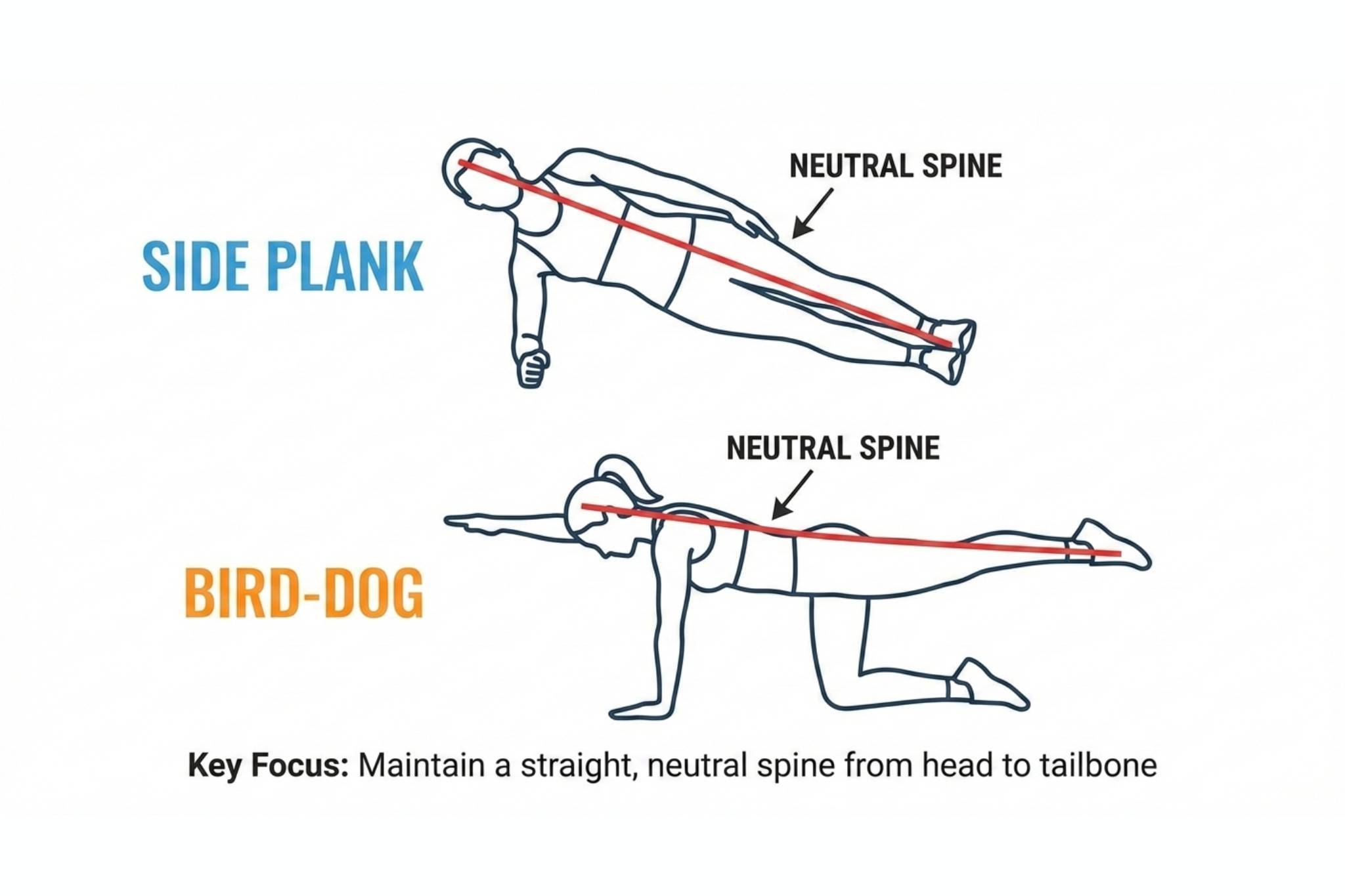
We replace crunches with exercises that train the core to resist movement and stabilize the spine. Our favorites include:
- Planks and Side Planks: Trains anti-extension and anti-lateral flexion.
- Bird-Dogs: Trains anti-rotation while moving limbs.
- Dead Bugs: Trains controlled movement while maintaining a neutral spine.
By focusing on these specific, stabilizing movements, you build a resilient core that is designed to protect your spine during dynamic activity, ultimately relieving your lower back pain.
Ready to Build a Functional Core?
If your back pain persists despite endless ab workouts, it’s time to change your approach. Stop aiming for a six-pack and start building a stable, pain-proof core.
Let your expert Saskatoon Chiropractor at E3 Chiropractic + Wellness assess your spinal stability and develop a personalized plan to address the root cause of your instability.



.jpg)
